A “New” Way to Get Around

As an employee of a major airline, I probably shouldn’t like this idea. However, as an environmentalist, opponent of traffic jams and the hassles (sorry, boss!) of airline travel, I see some benefit in high-speed rail.

My experience with trains involves not high-speed rail but slower commuter rail in major cities – London, Paris, Washington, Dallas, New York, and Chicago. I was always impressed by how many people these subway and light rail systems could move around. Jenny and I have taken the Trinity Railway Express to downtown Fort Worth and the American Airlines Center many times to avoid traffic and parking hassles.

Admittedly, I don’t know much about high-speed rail. I know they are popular and very successful in Europe and Japan. In terms of carrying a person or pound of cargo a given distance, they use less fuel and produce fewer emissions than a car, truck, or plane. Sure, even a high-speed train is much slower than a jet. However, if you account for the chance of flight delays and the extra time and trouble you spend at the airport prior to the flight, the difference in overall travel time drops.

Leaders in Texas have discussed a high-speed train network to link Dallas, Houston, and Austin at various times. It appears to finally have a chance of success thanks to significant private investment. Southwest campaigned strongly against the idea in the early 1990s for obvious reasons. You won’t see me campaigning against my employer, but I think the idea is at least worth considering.

Check out this article in Time for details about high-speed rail possibilities in the U.S., particularly in Florida.

Our New Ride

Ever since I started at Southwest, I’ve wanted to participate in a new aircraft delivery, the process of picking up a shiny new 737-700 from Boeing’s 737 factory in Seattle. After 9 years of waiting, I finally have my chance this week, and Jenny gets to go with me!

From what I hear, these delivery flights are tons of fun, with a more relaxed atmosphere, free food, and great memories with old friends and new ones. Several of my coworkers and leaders plan to attend. A couple of the senior management pilots will serve as the crew. Lord willing, we will fly from Dallas to Seattle Thursday afternoon. That evening we’ll meet some of my colleagues and leaders at a party at the crew hotel near Sea-Tac (SEA). Friday morning, we’ll take a shuttle to the factory at Boeing Field (BFI), have breakfast, visit the Boeing Store, take pictures of the new plane, and then fly back to DAL enjoying that new-plane smell.

At some point Friday morning, the SWA bigwigs will write Boeing a really, really big check (figuratively, I assume), and the Boeing bigwigs will transfer title for the aircraft to SWA. In some ways, it’s like buying a new car, just a lot cooler and more expensive. List price for a new 737-700 is $58.5-69.5 million, depending on configuration. I’m sure we get some sort of volume discount.

I’ll post pics over the weekend!

Florida One

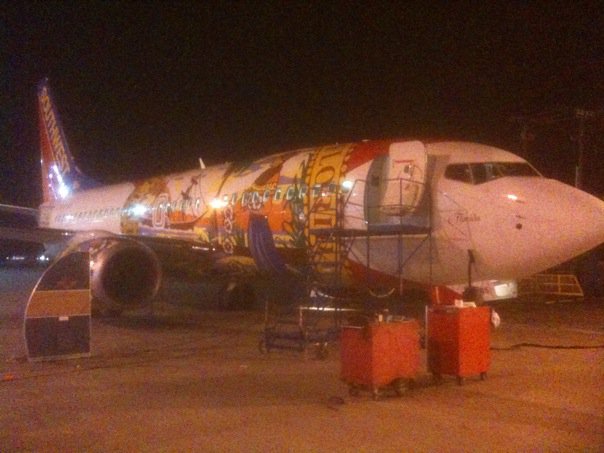
This month, to honor our existing Florida Customers and the upcoming debut of service to the new airport in Panama City, Southwest unveiled its latest themed aircraft, Florida One. Like all our state-themed planes, it bears a stylized version of the state’s flag. Luckily for me, Florida One terminated in Dallas Tuesday night and went to the maintenance area for a bit of minor work. Naturally, some of us had to go see it up close.

The End of the Shuttle

Only four launches remain in the long career of NASA’s space shuttle fleet. So far I’ve only seen one launch in person. When Jenny and I went to Disney World in October 2006, the shuttle launched on our first day at EPCOT. We were at least 40 miles from the launch pad, and the skies were mostly cloudy, but we got a distant view of the gorgeous streak of light through gaps in the clouds. We couldn’t hear a thing, but I was in awe and smiling like a little boy.

My closest encounter of any kind came after fourth grade when we took a family trip to Florida and toured Kennedy Space Center. One of the shuttles was sitting on the launch pad, gleaming in the sun. I was amazed to see a machine that could actually fly from the earth into space and return safely.

NASA’s Shuttle Mission Home

The final launch is currently scheduled for September 16, and Jenny and I hope to attend. Since shuttle launches often get postponed due to weather or mechanical problems, we might or might not succeed, but we plan to try. Through work, I’m in a lottery for a spot at the best possible civilian viewing area. We should find out a couple of weeks in advance whether we get the tickets. If not, we’ll plan to watch from a nearby site. Wish us luck!

Remaining Shuttle Missions

The Three-Hour Rule

The airline industry is abuzz regarding the upcoming “three-hour rule”, which forces U.S. airlines to allow passengers to deplane after no more than three hours of waiting on the tarmac. Congress passed this law in response to several high-profile incidents in which passengers were stranded for many hours due to bad weather and ATC delays in New York, Minnesota, Austin, and other areas.

In my opinion, this law is a classic example of politicians who are more interested in making their constituents happy than in actually understanding the problem and finding a good solution. At first glance, the three-hour rule might sound like a great idea. After all, who wants to sit on an airplane going nowhere for 12 hours with limited food and overflowing toilets? However, this new law severely limits our ability to operate in bad weather, will ultimately cause more passenger inconvenience, and will lead to a significant increase in flight cancellations.

Multi-hour taxi delays generally occur for one of two reasons: 1) Thunderstorms that prevent traffic from efficiently flowing to and from an airport, and 2) Frozen precipitation that causes lengthly deicing delays, makes the runways extremely slick, and sometimes prevents flights from departing or arriving altogether. Sometimes there’s no easy way to know how long a flight will take to go from the gate to the air.

For example, I once worked flights to and from several cities in the Northeast when a line of strong thunderstorms moved through, blocking many of the available “highways in the sky”. Due to the large number of flights and limited paths, the air traffic controllers were hardly allowing anyone to move, gridlocking much of the region. In several cases, all we could do was to add lots of fuel and send the flights out to get in line to depart. They had to wait in line until the storms moved off some of the departure paths. If a flight burned up too much fuel in line and needed to get more, or needed to return to the gate for “passenger convenience”, ATC put that flight in the back of the line once it came back out, resulting in an even longer delay.

As another example, the FAA has declared it illegal to depart in certain combinations of frozen precipitation, such as ice pellets (sleet), snow, and rain mixed together. WIth any frozen precip falling, the aircraft must be deiced prior to departure, which can take a long time. Once deiced, if one of the forbidden combinations of frozen precip falls on the aircraft, the pilots must 1) wait until that combination stops falling, 2) get deiced AGAIN, and 3) hope that the combination doesn’t reappear and force them to repeat the whole process. This is similar to what happened to jetBlue at JFK during their Valentine’s Day meltdown a few years ago. The flight needs to be ready to get deiced and launch when able, but since no one can know for sure what the weather will bring, sometimes the crew needs to get the plane out there and wait.

By forcing us to return to the gate after three hours for “passenger convenience”, we will lose valuable opportunities to launch flights during the sometimes limited windows that become available. Even more importantly, keeping passengers onboard beyond the three-hour mark can result in a fine of $27,500 per passenger. On our 737s, that would be over $3.7 million for a full flight. Rather than risk a heartstopping fine like that, the airlines will preemptively cancel many flights that could face multi-hour delays. So instead of potentially being stuck on a plane for a few hours before reaching their destination, some passengers will have their flights cancelled and won’t reach their destinations at all until a day or more later.

The law goes into effect in April, during thunderstorm season. I’m curious to see how big the impact will be. For more information, check out the following articles:

Three-Hour Rule Ready to Become Reality

Airlines Threaten to Cancel Flights