Quads of Steel and Puny Abductor Hallucii

Yesterday I went back to see my podiatrist, Dr. Crane at FAANT, for a follow-up after my near stress fracture from four weeks ago. Since my last appointment, I’ve been running exclusively in my trusty Adrenalines and worked back up to 4-mile runs with zero foot pain. Awesome. So I had two questions for her:

  1. Is it even possible for me to run in the Vibrams, and if so, how should I transition?
  2. What can I do about my nagging left knee pain?

I love Dr. Crane. She’s very nice and knows her stuff and has a cool confidence about her, but she talks and works quickly so you have to listen fast. She knows I’m paying good money for her medical opinion, and she expects me to listen and obey. I wish more doctors were like that.

After running several simple strength tests on my feet and lower legs, she gave me the following conclusions:

  1. My foot muscles, particularly the abductor hallucis muscles (the main muscle in the arch of the foot), are “puny”. (Just what every guy wants to hear from a lady!) On the plus side, it helps explain why my feet are so flat. She prescribed six simple exercises to strengthen my weak feet.
  2. The backs of my legs are strong, but the fronts are too weak. I need to stretch my hamstrings and calves like heck and strengthen my quads and the muscles on the front of my lower leg. I’ve already been working out my quads, and it’s definitely helped my knee pain. Today I’m going to pick up my dad’s bike for crosstraining. My friend Logan helped his knee pain by cycling, so I figure a good ride once a week would be a nice addition to my plan. Once I have quads of steel, I’ll be ready for a marathon, right? =)
  3. I am “young, strong, and faster than average”, (thanks!) so I should be able to run in the Vibrams. Awesome. However, the transition period will be “like watching paint dry”. She recommends adding a few hundred yards a week in them and finishing the run in more normal shoes. So it might be 3 months before I’m actually running a 5k in them. I could also get an in-between shoe such as a training flat to replace my Adrenalines.

So overall a good report! I did 4 miles Wednesday evening with no foot pain and only a very mild ache under my left kneecap, which is significant progress compared to this spring. Right now my biggest challenge is the heat. I do most of my running in the evening these days so I’m out of the sun. I might go race Saturday morning if I can find one I like.

How Much Are You Worth?

When I hear the term “net worth”, I first think about extremely wealthy people, the kind of people who have so much money that they pay people to manage it for them, the kind of people who get profiled in Forbes’ list of the wealthiest people in the world. Warren Buffett. Bill Gates. Oprah. Those folks.

But really we all have a net worth. It’s simply a measure of how much you have (assets) versus how much you owe (liabilities). And it can be a handy grade for how you’re doing financially. If your net worth is negative, you’re probably in trouble. If it’s positive, in theory you’re doing OK. If it’s very high, you’re probably doing well. However, it’s not that simple. If you could instantly sell all your assets and use the money to pay off all your debts if necessary, you’d still be above water if your net worth is positive. But some assets like houses aren’t so easy to sell. Even some financial assets, such as retirement accounts or CDs, aren’t the same as cash in the bank because they are more difficult to use and can involve penalties if used too soon.

Our situation is pretty straightforward. Our main assets are our retirement accounts and our home. The same is probably true for many of you. Our secondary assets include shorter-term investments, cash, two vehicles, and personal property. Our only liabilities are the mortgage for the house and some student loans.

I won’t post our numbers here since it seems a bit tacky, but there are people who are very open about their net worth and even post it on their blogs or turn it into an online competition. Curious about how you compare to your peers? Try CNN Money’s Net Worth Calculator.

To figure out our net worth, we could go old-school and list all our assets and liabilities on a piece of paper and add everything up, as explained in this article on About.com. Or we could hire a financial advisor like my friend Chris who has lots of letters after his/her name. But instead, we do it the easy way – make Mint.com do all the work for us and update it whenever we want.

A couple of years ago, I told you in this post about Mint, a personal finance website that can pull in your financial data from a variety of different sources and organize it a single convenient view. It can easily add up all your assets and liabilities and calculate your current net worth so you know how you’re doing. It’s not perfect. Certain websites that have unusual security measures such as multi-level authentication don’t play nicely with Mint. However, most of them work just fine. If you’re concerned about security, know that Mint has no ability to make transactions on your accounts, only to retrieve current balances. And it even has an iPhone app. Every day I use my phone to see which transactions have cleared and how much I have in my accounts. It’s been a bit depressing lately since my stock and fund balances have been declining in the market downturn, but at least I know where I stand overall. I hope you do as well, whether it’s through Mint, Quicken, a financial professional, or your own hard work.

10-Year SWAnniversary

After graduating from Baylor in May 2001, I lived with my parents for a few weeks and then started my first full-time job in June. Although I’d heard of Southwest and actually flew SWA once to a college interview in Houston back in high school, I’d never really considered working there until January 2001. I was on an email list for tech writing jobs and saw an opening for a Technical Writer I at Southwest. I applied and got the job, which is always good news for parents of recent college grads who need to leave the nest for good.

Inculturation

I was part of a new-grad program in the IT department called SMART Camp. SMART was an acronym for something, but I’m not sure whether anyone remembered it. Most of us started on June 25 and entered six weeks of on-the-job training. At most companies, this training would have been technical stuff like Java programming or database management. But SWA likes to do things differently, so we spent the first six weeks not doing “productive” stuff, but learning about the company and its wacky culture. We sat with reservations agents and tech support reps. I flew out to Midland and hung out on the ramp for a while. We played water balloon volleyball. We took turns using the emergency slide in a mock aircraft cabin.

Yes, it was fun, but it also served a strategic purpose: making us diehard fans of Southwest. It worked. Of the 22 or so young IT folks in the program, nearly half are still at Southwest 10 years later. In the IT business, where you often move up by hopping from company to company, that’s a big deal.

Career Moves

I spent about 3 ½ years in the IT department, starting with tech writing projects and then branching out into software design, business analysis, and technical training. Along the way I discovered the Dispatch department through some of my tech writing projects and decided it was time to leave IT and dispatch airplanes for a living. I joined Dispatch as an Assistant Dispatcher in January 2005, upgraded to Dispatcher in January 2006, and became a Dispatch Trainer in October 2008. I’ve spent nearly 2/3 of my time at SWA in Dispatch, and I hope to stay here for decades to come. You can read more about my job on my professional page.

Changes and Cornerstones

Much has changed at Southwest over the last decade. We’ve added many new airports, including several congested ones that we wouldn’t have touched 20 years ago such as Philadelphia and LaGuardia. My wife joined me at SWA in the People Department from 2003-2008, doing an outstanding job as an Administrative Assistant, Flight Ops Employment Coordinator, and Onboarding Project Specialist until she retired to stay home with the boys. The Dispatch office has been in two different locations. The current one is actually in the same space where my IT desk used to be. The biggest changes lie ahead in the next five years as we integrate AirTran’s operations with our own, add the 737-800 and 717 to our fleet, add dozens of new AirTran airports, and begin international operations.

Despite all the changes, much has remained the same. Our culture of hard work, fun, LUV, and quirkiness remains one of the foundations of our business. It still feels like a family here, with both the caring and drama that families provide. I believe in our leaders and coworkers. Our company is as stable and secure as any company in our crazy industry. I’m still just as proud and grateful to work here as I was ten years ago. How many people can honestly say that about their employers?

Highlights

  • The surprise wedding shower that my tech writing team threw for me and Jenny
  • Seeing my change management software actually getting used and making a difference
  • The friendships I made in both departments
  • Getting the call to join Dispatch – I rushed down the hall to Jenny’s area to tell her in person
  • Seeing an Assistant Dispatcher whom I trained working a desk on their own – “It’s the ciiiiiiiircle, the circle of liiiiiiiiiife”
  • Getting named Dispatcher of the Quarter for 1st quarter 2007
  • The thrill and relief of seeing the “on the ground” message for every problem flight
  • Going with Jenny and her awesome People people to MDW, BWI, MCO, OAK, LAS, SAN, and PHX to support Onboarding
  • Getting to ride in the cockpit
  • Bringing home N949WN from Boeing Field with Jenny and dozens of coworkers

Party Time

On Saturday night, Jenny and I get to attend the annual SWA Awards Banquet at the Anatole, which is for the 10/15/20/25/30/35/40-year anniversaries plus some special awards. A few thousand people will be there, and we’re dressing up in our best. Saturday also marks the 40th anniversary of Southwest’s first flight, and we have a handful of Original Employees who still work here after four decades. One of them is actually in my office.

It’s been an amazing journey, a mixture of exhilaration, stress, hard work, fun, frustration, and joy. No, Southwest isn’t a perfect company, but it’s pretty darn good. It’s hard to imagine working anywhere else, nor do I want to. The next few years are full of promise. I still drink the Canyon Blue Kool-aid and will gladly offer you a glass.

Quote for the Day – June 17

Submission to what people call their ‘lot’ is simply ignoble. If your lot makes you cry and be wretched, get rid of it and take another. –Elizabeth von Arnim, New Zealand-born British novelist

Posted in Fun

The Hidden Winds in Our Sails

In Malcolm Gladwell’s fascinating book Outliers, he analyzes some of the hidden influences behind some of the world’s most and least successful people. Americans generally credit success to virtues such as hard work and talent. Anyone who is not successful simply doesn’t work hard enough and/or isn’t talented enough to succeed. Gladwell’s book turns these ideas upside down and provides numerous examples of additional factors. Part I focuses on the opportunities, or lack thereof, that play a role in one’s success. Part II addresses some cultural factors that make some groups of people better than others in a given discipline.

Part I really made me think about my own life. Obviously, I’m not rich or famous or powerful. However, although it’s difficult to examine one’s own life objectively, I think my life is pretty successful by American standards. (whether those standards are legit is a much different question) I did well through high school and college, including several awards and scholarships. After graduation, I got a job with a great company and still work there today doing something I really enjoy. Along the way I earned a master’s degree just in case my current job ever fell through. I got married soon after college to a great woman and now have two beautiful little boys. We own a nice home. I make a good living and, barring any unforeseen meltdowns, should have plenty saved up for a comfortable retirement. Most of my major life goals are already complete. My life isn’t perfect by any means, but it’s pretty darn good.

How did all this happen?

It can be tempting to take the credit, to convince myself that *I* am smart, *I* am driven, and *I* work hard, and that those qualities are responsible for my “success”. Gladwell demonstrates quite effectively that the truth isn’t nearly that simple. There are plenty of people who are smarter than me, more driven than me, and/or work harder than me who aren’t pleased with how their lives are going. In my case, I was blessed with a fantastic support network and other advantages that played a huge role in helping me succeed. Here are some of the outside influences and opportunities that Gladwell mentions along with how they applied in my own life:

My Birthdate

No, I’m not talking about astrological hocus-pocus, but my birthdate relative to the school calendar. In Texas, the cutoff date for deciding when to enroll a child in school seems to be September 1. Children born on or soon after that date are generally among the oldest in the class, meaning they’ve had more time for their brains and bodies to mature before starting school. Those kids who seem brightest get special attention and opportunities, whether it’s because they actually are smarter or simply because they are older and more mature. This special attention adds up and multiplies over time as the high achievers get to try enrichment programs and honors/gifted classes.

My birthdate is October 23. I tried to look up or remember the birthdates of the top ten students in my graduating class and found seven of them. Of the seven, five were born in August, October, or November of 1978. One was born in February 1979. One guy broke the mold with a September 1979 birthdate and was simply smart enough to overcome his “deficiency”.

My Family

My family was very supportive of me and helped me in ways I’m still discovering as a 32-year-old. Gladwell discusses two different parenting styles and their impact on their children’s achievement. One style, common among middle- and upper-class families, has been called “concerted cultivation”. The parents play an active role in nurturing their children, encouraging their interests and talents and giving them opportunities to explore them, and teaching them how to shape the world to their desires. Another style, more common among poor families, is called “natural growth”. It’s a more hands-off approach in which the parents provide basic needs but let their children grow in whatever direction they want, or none at all.

My parents took the concerted cultivation approach. They got me interested in reading early on. As I went through phases of interest – dinosaurs one year, sharks the next – my parents found ways to encourage those interests. Sometimes it meant lots of trips to the library. It meant bringing home a typewriter (remember those?) so I could learn to type and then a computer so I could learn how to use it. During my dinosaur phase, they took us to a dinosaur museum in Utah that had real dinosaur bones partially excavated. When I entered the spelling bee, my mom spent hours drilling me. They took me to voice lessons, tennis lessons, taekwondo lessons, college entrance workshops, whatever it took to get me where I wanted to go. My grandfather loved, and still loves, to discuss current events with me even though I was a kid and had very little clue what I was talking about. In sum, my family treated me like I was worthy of investment and expected me to work hard with everything I’d been given. So I did.

Opportunity

Gladwell tells stories about several very successful people such as Bill Gates and The Beatles who happened to be at the perfect place at the perfect time. Whether I’ve ever been in the perfect place at the perfect time is a question far above my pay grade. However, the track of my life has benefitted from certain circumstances. For example, I happened to have an English teacher (Mrs. Picquet) who liked my writing and encouraged me to pursue it. Although I never made a living as a creative writer, I decided to major in writing in college. During my junior year with Mrs. Picquet, partly due to her guidance, I aced a test that made me eligible for a plethora of scholarships. Baylor’s scholarship offer happened to be one of the best in the nation, which led me to do my undergrad there. Baylor happened to have a degree in writing, which I ultimately declared. Southwest Airlines had a college recruiting program that focused on four major universities. One of which was Baylor, and my affiliation with the school helped me get the job. Although I didn’t like the tech writing job too well, it led me to a field I’d never even heard of but now love – flight dispatch. I finally got to join the department at a time when the airline was growing quickly, so I’ve gotten to move up quickly in seniority. Now I’m 32 years old, with a fantastic job that’s extremely secure at one of the best companies in the world. Did I work hard to get here? Definitely. But without Mrs. Picquet, and Baylor’s generous scholarship program, and getting assigned to work on a Dispatch project during my days as a tech writer, my life might look much different right now.

I could go on and dig deeper into some cultural issues and other factors, but you get the point by now. Many people and circumstances have helped me in many ways to get where I am. Ultimately I credit God, who in some mysterious way works in our world to accomplish His purposes and made my life possible. May I be forever grateful for the hidden winds in my sails.

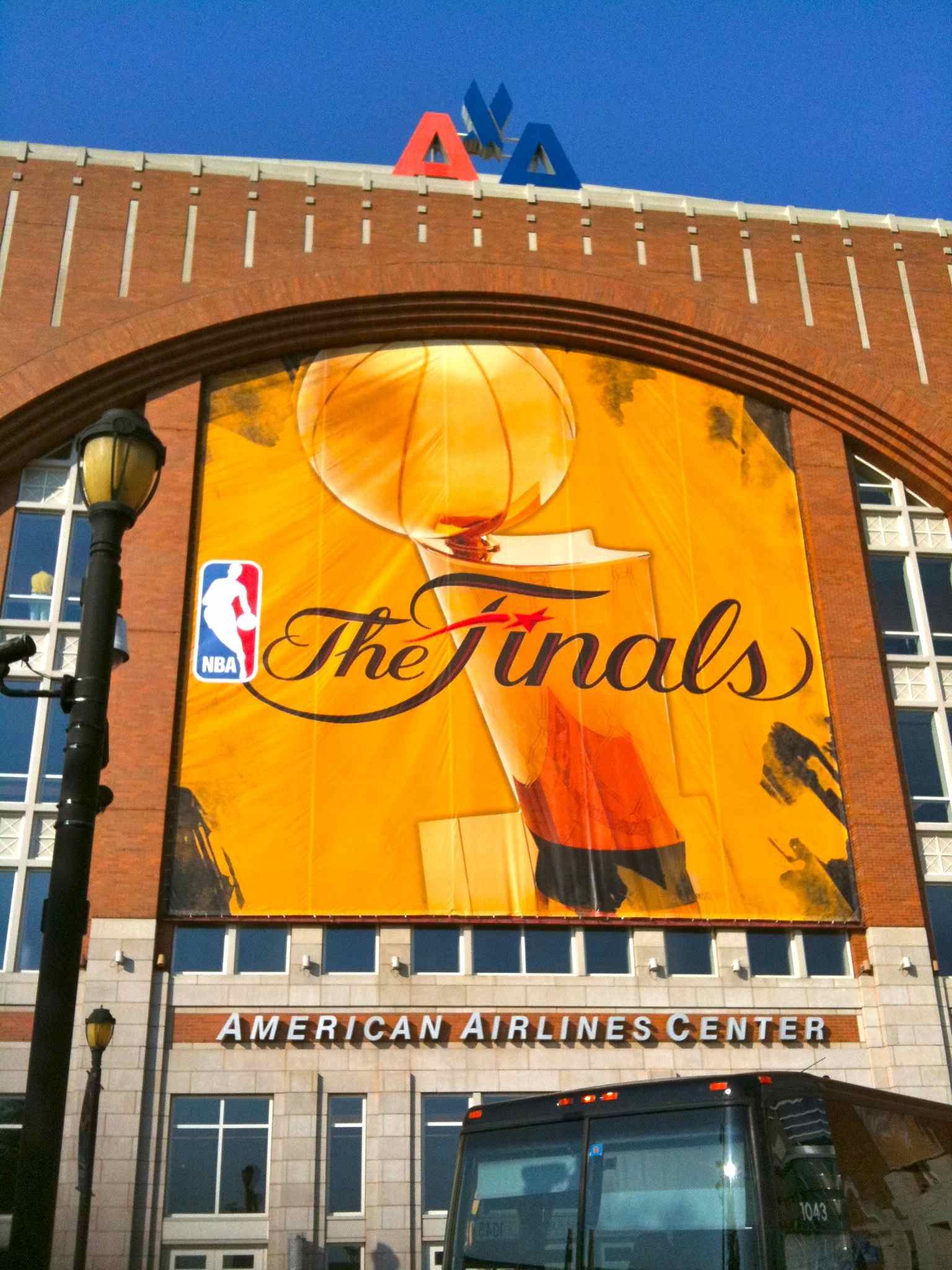
NBA Finals Game 5

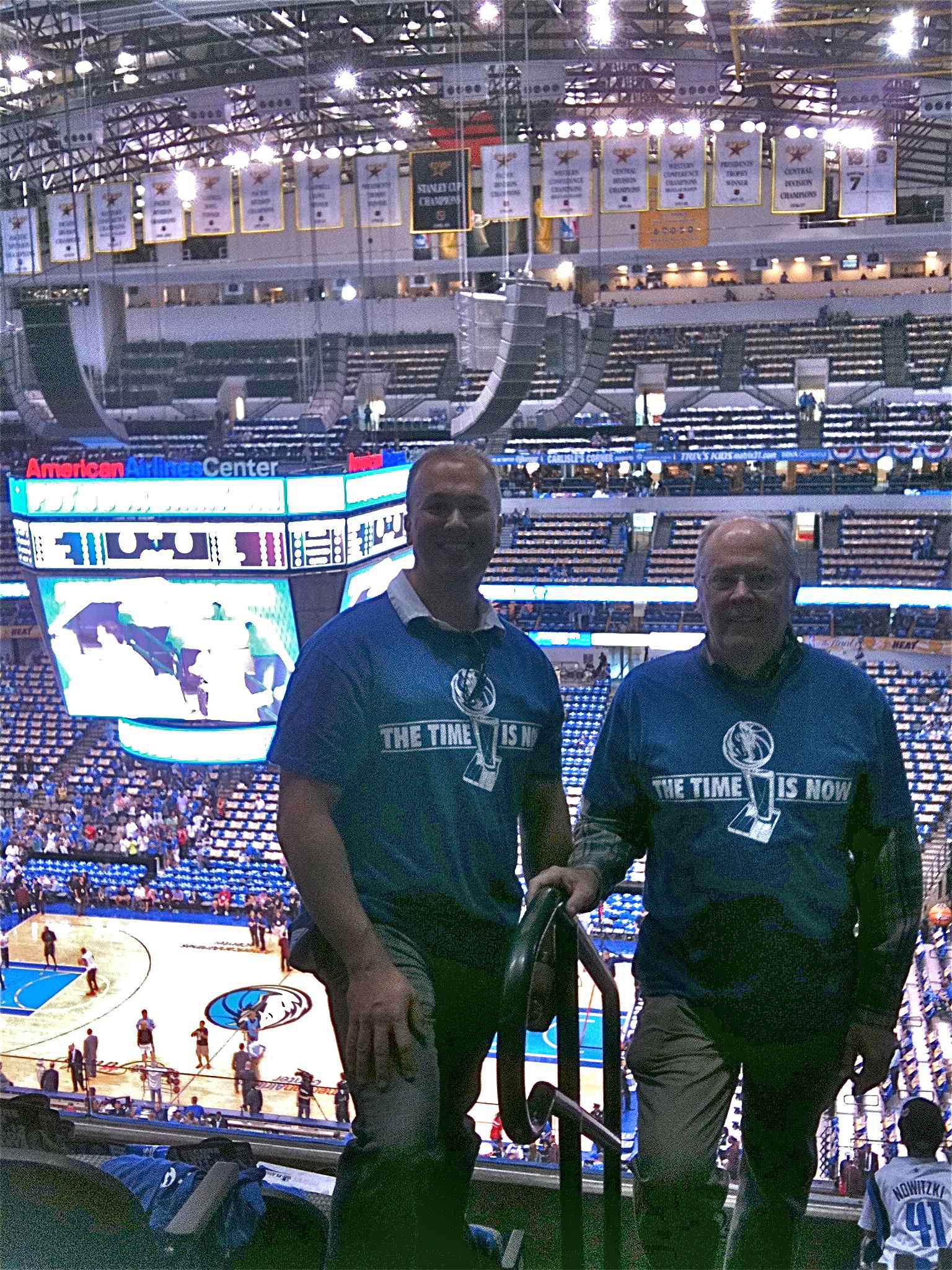
Thursday night my dad, brother-in-law, and I got to scream our heads off watching the Mavs beat the Heat in Game 5 of the NBA finals. I hadn’t been to a Mavs game since December 2001, when Jenny and I went on our first unofficial date. What a way to get back into live basketball! We took the TRE to the American Airlines Center.

I like how the NBA writes the series name in script. Very classy.

We grabbed a quick bite and found our seats. Dad and Phillip had seats together. I was scheduled to work Thursday night and begged my coworkers to pick up my shift. Finally one friend took pity on me. I didn’t find out I would be able to go until Wednesday night, so my ticket was in a different section.

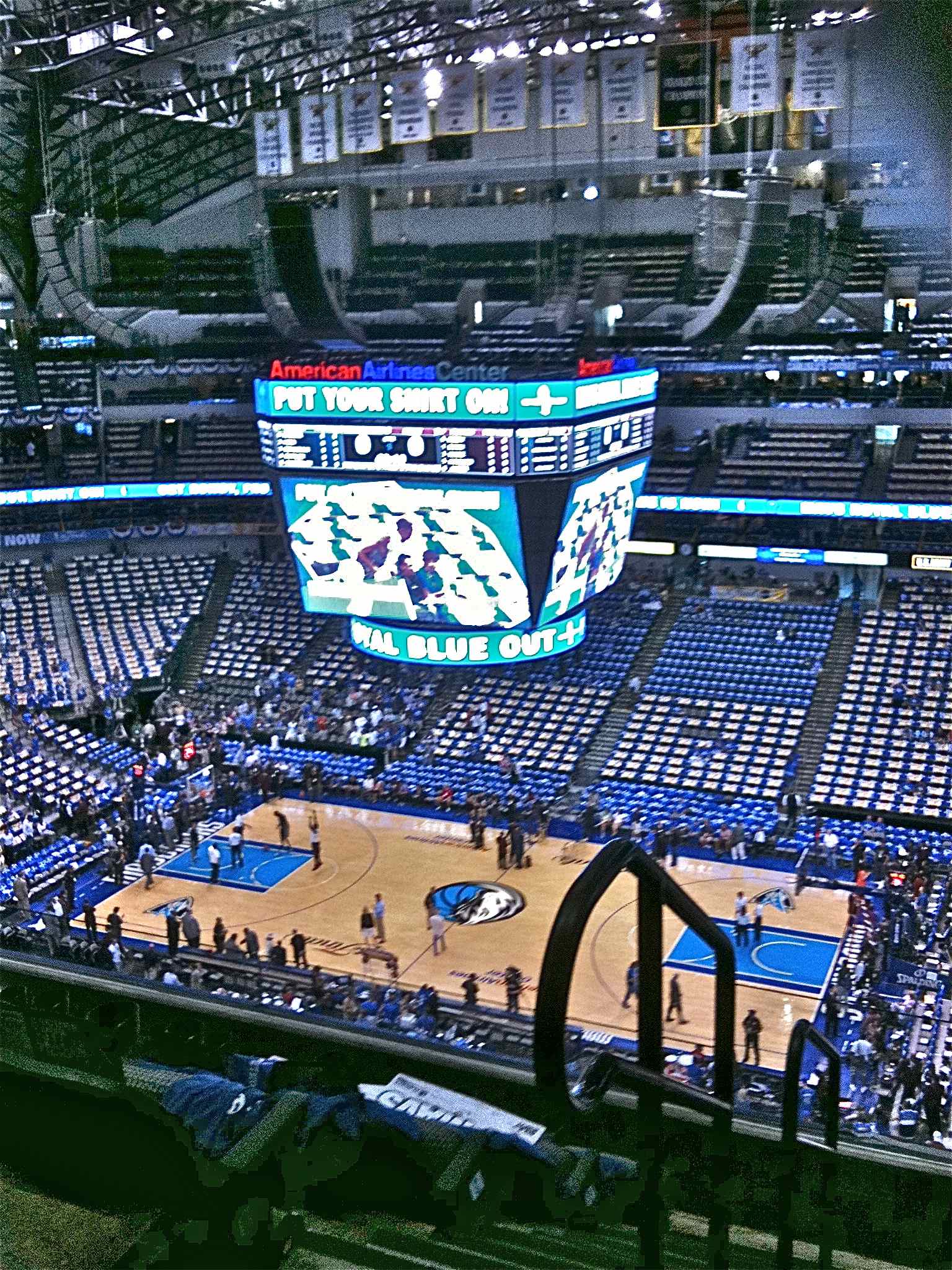
The empty court before the game. Even after the game started, I was surprised to find several open seats, including three next to me. Phillip also had one next to him, so I joined them after the first quarter.

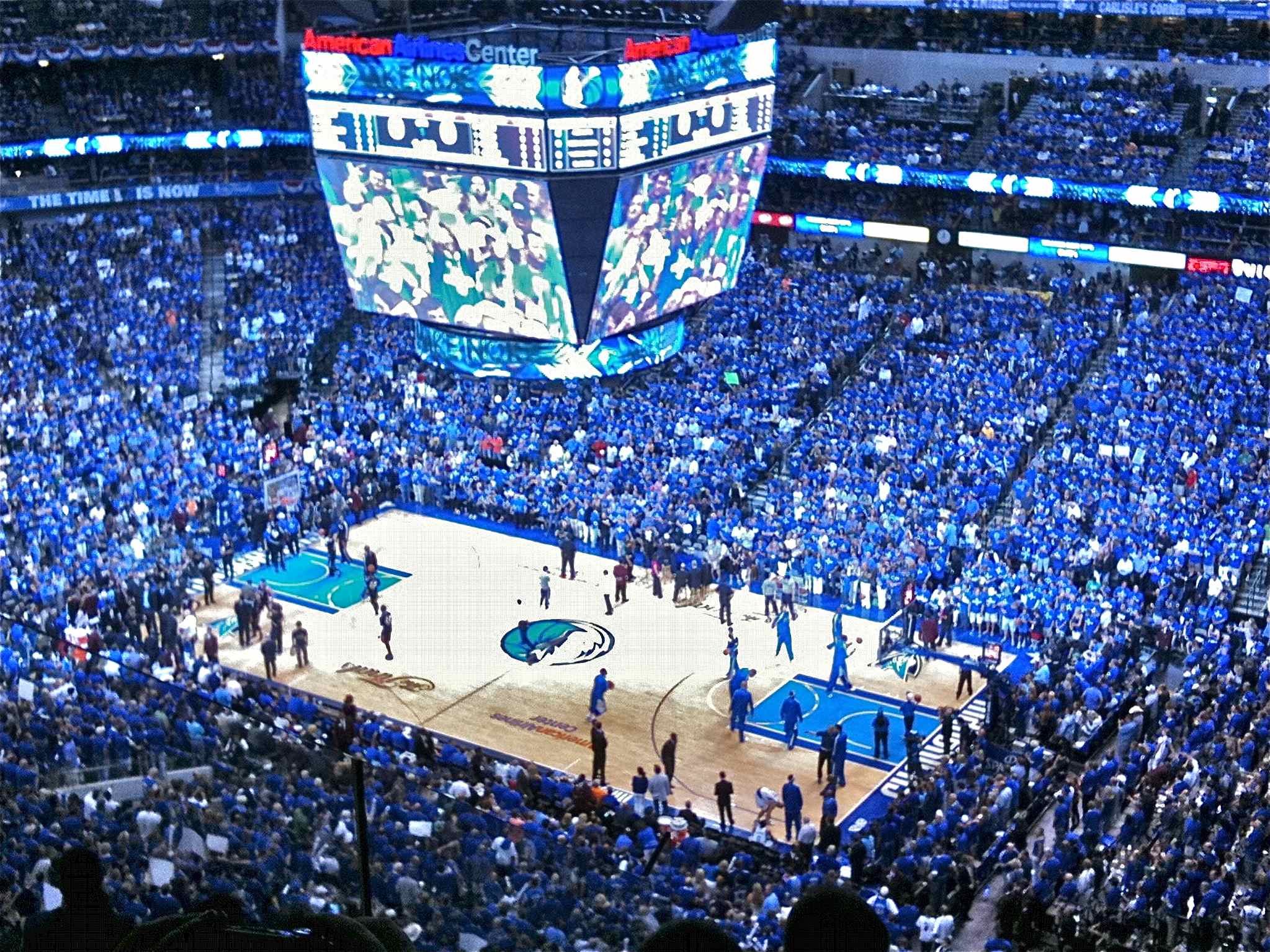
Every seat received a blue THE TIME IS NOW t-shirt to wear. Before the game, the cameramen focused on people who hadn’t put theirs on yet. The announcer harassed each person until they complied. Peer pressure works on sports fans, too. I loved seeing nearly 20,000 people all wearing the same royal blue shirt. We also got inflatable clappers to make noise.

The game was fantastic. There’s nothing like the energy of a huge crowd during a finals game. It felt very similar to the NHL Western Conference Final game that Jenny and I attended a few years ago. The crowd is loud, rowdy, thrilled to be there, and expecting to see greatness. I’m certainly not a basketball expert, but I can appreciate two great teams playing a great game. The lead changed hands just enough times to keep the game comfortably dramatic. Then as the end approached, and it looked like the Mavs would probably keep the lead, we blew off the roof. It’s weird but strangely cool to have an excuse to high-five the tipsy strangers next to you.

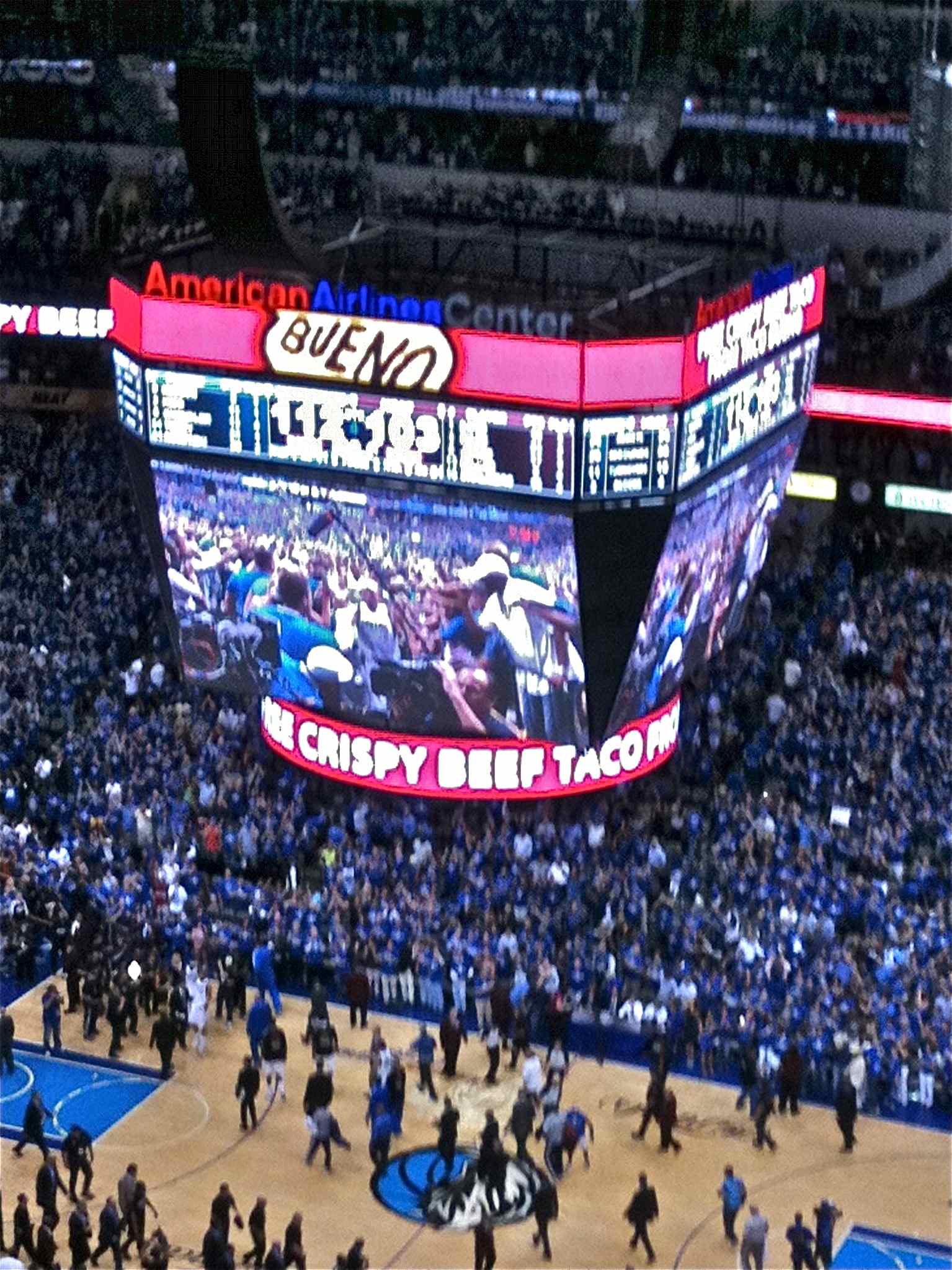
VICTORY! The final home game of the season goes to the Mavs, putting us up 3-2 as we head back to Miami to close it out.